My Favourite Collection – Erin Walsh, Port Hope Archives

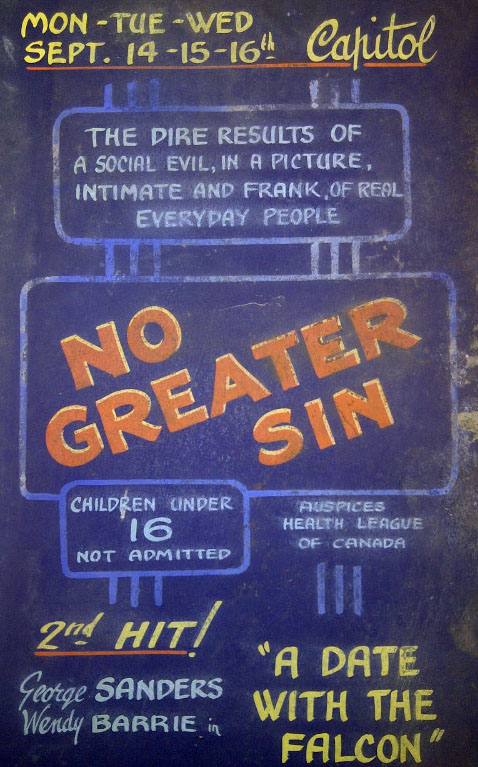
It was Valentine’s Day 2013, when one of the most vibrant and interesting collections at the Port Hope Archives came through our door: the Capitol Theatre Poster Collection (PHA#2013.5).

2013-5-4 - No Greater Sin Poster

2013-5-4

The collection consists of 14 hand-painted posters created by staff at Port Hope’s Capitol Theatre, c1941-1942.  The posters contain information on movies that were to be shown at the theatre.  It includes:

“Two Yanks in Trinidad”

“The Men in Her Life”

“Ship Ahoy”

“A Bedtime Story”

“Her Cardboard Lover”

“This Gun for Hire”

“No Greater Sin”

“I Married an Angel”

“Adventures of Martin Eden”

The posters were in generally poor condition when they were donated, because they had been discovered during the process of a renovation.  Even so, they cleaned up quite well, and have been a great source of entertainment in our reading room ever since!

“No Greater Sin” is a 1941 film about a local health official who tries to stop the spread of VD in a town.  Starring: Leon Ames, Luana Walters, Pamela Blake.

Posted in DRAAG Information | Leave a comment

This Month’s Header

The photograph comes from the collection of the Oshawa Community Archives and shows the members of the fire department in 1922. The fire hall shown in the background was located at the corners of Richmond and Simcoe Streets.

Oshawa’s first fire department, which was organized in 1870, was made up entirely of volunteers. P. Thornton was the first to organize and equip the volunteer company and as a result, became the first fire chief.

Before the waterworks system of hydrants, water for fighting fires was supplied from domestic wells or underground tanks. The largest storage tank was built of concrete and was located beneath the Town Hall at the southwest corner of Richmond and Simcoe Streets (the Town Hall also served as the Fire Station and Police Station). Other tanks were built of cedar logs and were placed at several suitable locations in the downtown area. The tanks were usually filled by rain water from roofs and ditches, but if necessary, water had to be hauled in to maintain a suitable level.

When the bell in the tower of the Town Hall clock rang, teams of horses from the livery would come running up the streets towards the Fire Hall and were then hitched to the fire equipment. The volunteer firemen would either run towards the Town Hall or go to the nearest intersection indicated by the location signal of the second alarm. Here they might make a jump for one of the fire carts as it passed by.

Prior to 1873, the only fire fighting equipment available for the Oshawa volunteers was a manual pump. This “relic” was replaced by a steam pumper, which was much more efficient. Then in 1917 the first motorized unit, a Chevrolet truck, was purchased and served for 11 years as a hose and chemical unit.

For more information on firefighting in Oshawa, visit the Oshawa Community Museum located in Lakeview Park, Oshawa.

A980.5.3

Posted in DRAAG Information | Tagged , , , | Leave a comment

This Month’s Header

The photograph comes from the collection of the Oshawa Community Archives and shows the employees of the Oshawa Laundry and Dry Cleaning Company.

The photograph shows the Centre Street location, where the company moved to between 1921 and 1928.

A982.31.1

Posted in DRAAG Information | Tagged , , | Leave a comment

AAO 2014 Conference

CaptureWe are less than a month away from the AAO Conference at UOIT in Oshawa. Registration will remain open until Friday, May 16. You can still register online here: http://aao-archivists.ca/event-1693121 Please contact the AAO Office at aao@aao-archivists.ca  or 647-343-3334 if you require assistance.

 The conference program is available online. You will receive a hard copy at the conference.

http://aao-archivists.ca/Resources/Documents/AAO%202014.pdf

Looking forward to seeing many of you on May 28!

Posted in DRAAG Information | Tagged , , , , | Leave a comment

Meet the Archivist – Emily Cartlidge, Northumberland County Archives

Up next is Emile Cartlidge, Archivist for the Northumberland County Archives.

cartlidge2bw-SEmily graduated from Brock University with an honours degree in  History.  She continued on to earn her Masters in Library and Information Sciences from the University of Western Ontario.

What do you do at the Northumberland County Archives? 

I am the Records Manager & Archivist which means that I manage the corporate records from creation to destruction or long-term preservation. I’m also responsible for maintaining the archival collection.  The archival collection is made up of historical documents or records related to the history of Northumberland County – both the Corporation and the geographic area. We also provide archival services to our lower tier municipalities and store and provide access to the archival materials of the Town of Cobourg, Township of Alnwick-Haldimand and Cramahe Township. Within the collection, we have by-laws, assessment rolls, Council Minutes, photographs, maps, oral histories, newspapers, land deeds and abstracts, diaries, personal correspondence and much more.

It is my job to ensure that this information is preserved and made available to those interested in researching.

Why did you choose this career?

I was on exchange to Wales during my third year of university and travelled to some of the major Museums and Libraries in Europe. Being a Medieval History student and seeing some of the finest examples of medieval maps, books and documents on display and accessing them for research, really sparked my interest in Archives. When I returned to Brock University for my fourth year, I volunteered at the University’s Special Library and Archives and fell in love with the profession.

What is your favourite part of your job?

Holding history in your hands and the fact that every day is different.

What do you find to be the most challenging part of your job?

Inventorying the collection and creating usable descriptions for researchers. It’s not the task of inventorying and describing materials that’s challenging, it’s getting through the large volume of materials in the collection in a timely manner for researchers that’s the challenge!

How did you get into the archival field? 

To make sure this field was a good fit for me, I volunteered at various archival institutions in Ontario and Wales. After gaining some essential archival skills and first-hand experience, I completed my Master of Library and Information Science at the University of Western Ontario in 2009 (where I continued to volunteer throughout and after my studies). My first Archival position came when I was hired on as the Museum and Archives Assistant for the St. Marys Museum in St. Marys, Ontario where I worked for a year and a half before accepting a position with Northumberland County in my hometown of Cobourg in 2012.

What is your favourite memory of the Archives?

My favourite memory of the Archives is the day we installed our compact storage units. Before installation, we had room for only 18 more bankers boxes of materials before our one storage room was full. With the hard work and support of our volunteers re-boxing materials and emptying the room, we were able to install the new shelves and create space for over 400 additional boxes!

Do you have a favourite artifact?

My favourite artifact is the 1808-1820 Roads Petition Book for the Newcastle District. In this book kept by the chief surveyor of the Newcastle District are listed all the names of landowners who petitioned the District to construct new roads as well as the measurements and surveyors thoughts on the proposal. It’s pretty awesome because many of the roads that were petitioned for then are still in use today and form many of the major routes throughout the County!

Posted in DRAAG Information | Leave a comment

Meet the Archivist – Ciara Ward

The next member we are profiling is Ciara Ward.

photo (2)Ciara earned her Bachlor of Arts (honours) in Art History from Queen’s.  She then was awarded a Master of Library and Information Sciences from the University of Western Ontario. Ciara isalso Director without Portfolio for the AAO and Co-Chair of the AAO Professional Development Committee

How did you get into the archival field?

When I was in my third year of my Art History BAH I had the opportunity to take a course about Canadian Photography, and it changed my entire world. Previously I had been debating about specializing in the Renaissance (same as almost everyone in my year) because I thought maybe I’d work in an art gallery or museum, maybe even teach. I ended up choosing Canadian Photography as an elective course, just to be different. My Professor for this course (and all the other photography courses I devoured after) previously had a career working at Library and Archives Canada as a photo archivist, so the entire course was actually taught from the archivist’s point of view. I remember on my first day she showed us a slide of Humphrey Lloyd Hime’s Prarie Looking South, and explained to us why she felt it was the perfect example of how photography can be more than “just a photograph”.

I couldn’t get enough of it – looking at photography as a historical document, rather than an art object; it changed my entire perspective. This Professor enabled me to complete an internship at the Queen’s University Archives, where I worked on the Albert Alexander Chesterfield collection, which (among other things) is a collection of early fur-trader photographs-as-documents. Thus began my decent into the archival world – to this day I’ve never forgotten the feelings I had the first time I opened those banker boxes and saw those photos.

What is your favourite part of being an archivist?

For me this is a tie; on one hand it’s an amazing feeling to help people of all ages have the same discovery that I had – that archives can change the way we look at, and relate to, our personal and national histories.

On the other, the community is incredible, and supportive. I can’t say enough about how archivists are always willing to help each other, always looking for ways to collaborate, and always, always promoting advocacy for the profession. We (archivists) really, and truly believe in our profession, and we want others to as well.

What advice would you give students hoping to become archivists?

Get involved and volunteer! Local Heritage Societies, Museums, Art Galleries, Local History Services, and Archives are always looking for volunteers, and it’s a great way develop your skills and pick up new ones. I’d also recommend becoming involved in your local Chapter of the Archives Association of Ontario (AAO), not only will you gain some great experience, but you’ll have the opportunity to work with and meet many archivists in your area, and across the province.

What is your favourite memory of working as an archivist?

Again, I have two. The first is working on a research project for the Rescue Mediums television show – it was fun! I never thought as an archivist working in a small, community archives I’d be working with television producers, but it goes to show you that this profession has a very diverse user base.

The second is working with the local high schools, veterans of all ages and service experience and veteran organizations to compile, edit, and make available the oral histories of our local veterans. One of the main goals of this project was to prove that you “don’t have to be old to be a veteran”. Students interviewed veterans ranging in age from 19 to 96, whose background varied from Afghanistan to Bosnia to World War Two to various training and Peace Keeping missions. Every day I saw the profound effect these oral histories had on both the students and the veterans, and it was truly an honour to bring such a project to life. This project led to collaborations with the Memory Project as well as a nomination for the Governor General’s history award – but it also created some lasting relationships between our local veterans and students.

Posted in DRAAG Information | Tagged , , | Leave a comment

Meet the Archivist – Leah-Ann Logel, Port Hope Archives

Our next member is Leah-Ann Logel of the Port Hope Archives.

Leah-Ann Logel Port Hope ArchivesLeah-Ann is new to this position as she just started in February 2014, replacing Erin Walsh while she is off on maternity leave. She completed her honours degreee in history from Trent University and earned her diploma in Museum Management and Curatorship from Sir Sanford Fleming College.

What do you do at the Port Hope Archives? 

I am the Archivist at the Port Hope Archives. As the archivist I am responsible for caring for the collection, meeting with and assisting researchers, outreach and education and many other administrative duties.

Why did you choose this career?

When I was in fourth year university, a professor of mine suggested that I apply for the Museum Management and Curatorship program at Fleming College. During this program, I was exposed to a number of different areas of museums and worked on a variety of different projects. My passion has always been history and now I am surrounded by it every day!

What is your favourite part of your job?

My favourite part of my job is that I learn something new each and every day. Whether I am completing research for a display or an article, assisting a researcher, or working with the collection, I am always learning something new about residents of Port Hope, and the Municipality itself.

What do you find to be the most challenging part of your job?

The most challenging part of my job is when a researcher is looking for information about their family or a property and we do not have what they are searching for. While we do have many resources at the archives, it is unfortunate when researchers leave without finding the information they were hoping to find.

How did you get into the archival field?

After completing my internship at the Prince Edward County Museums as part of the Museum Management and Curatorship program at Fleming College, I worked in Guest Services at the Waterloo Region Museum. While working there, I applied for the Temporary Archivist position at the Port Hope Archives and I was hired. I have only been working here for about six weeks but I have been enjoying my time so far!

What is your earliest memory of the Port Hope Archives? OR What is your favourite memory of the Archives?

My favourite memory from the Port Hope Archives was when I had the opportunity to view film reels from the 1950’s. It was interesting to look at Port Hope from that time period and see the ways it has changed and stayed the same since then. In my opinion, viewing these film reels was a lot different than looking at photographs and I am glad I had the opportunity to see these.

Do you have a favourite artifact or collection?

My favourite item in the archives collection is a welcome package that was given to new residents of Port Hope during the 1960’s. The welcome package was titled “Hi Neighbour” and was used to introduce new residents to local businesses and amenities in Port Hope. Inside the package, coupons were provided, by businesses or other residents, such as a discount at the barber or a freshly baked pie.


Posted in DRAAG Information | Tagged , , , , , | Leave a comment

Meet the Archivist – Sarah Ferencz, Whitby Archives

Our next member profile is that of Sarah Ferencz of the Whitby Archives.

photoSarah began as the Digitization Technician in 2009, in 2011 she became the Archivist Librarian and took on the role of Archivist in 2013 after the retirement of longtime Archivist Brian Winter.

Sarah graduated from University of Western Ontario with a specialization in history and a minor in classics.  Sarah continued her education at UWO by earning her Masters in Public History.

What do you do at the Whitby Archives?

As Archivist, I am responsible for preserving, cataloging, organizing, describing, and making accessible our collection of photographs, negatives, audio-visual material, documents, correspondence, ephemera, and other paper-based items. Assisting the public with research inquiries (genealogy, school projects, government research, etc.) is also a pretty big part of my daily routine. I lead workshops on preserving family collections and conduct outreach to local organizations and schools.  The Archives Technician is responsible for digitizing our photographs and negatives, of which we currently have over 7500 online. Right now I’m working on cataloging our map collection and I hope to digitize a couple of the more interesting ones soon.

Why did you choose this career?

During my undergrad, I studied history and became increasingly interested in the little details of the past that can only be learned from reading a handwritten letter, examining a photograph, or analyzing data ledgers. There is something inherently intriguing and enlightening in archival material and I came to learn more from these items than reading any secondary resources. I completed my MA in Public History because I wanted to explore how to convey my experiences with archival material and history in general to others.

What is your favourite part of your job?

Like Jennifer said, I enjoy that every day at the office is different. Today I’m cataloging the maps but tomorrow I might assist a researcher in finding an important piece of information that helps complete their family tree. I feel a great sense of accomplishment when I have arranged and described a collection so that it can be accessed by researchers. I am also lucky that my work allows me to be involved with the Archives Association of Ontario and I enjoy working with the network of archivists in Durham Region.

What do you find to be the most challenging part of your job?

Sometimes it is difficult making decisions that directly or indirectly affect the record of Whitby’s past. For example, our Collection Policy is very specific about the items we acquire for our collection due to space restrictions, limited resources, and/or local, historical relevance. Whether I want to or not, we just can’t accept donations that don’t comply with our policy and this can be a difficult realization to come to when ultimately my main objective is to preserve Whitby’s history.

How did you get into the archival field?

One of the requirements for my MA in Public History was to complete an internship at a heritage institution. I was lucky enough to secure a position at Library and Archives Canada where I was responsible for arranging and describing two collections.  It was a great experience and I had a very supportive supervisor whose confidence in me inspired me to search out other archives jobs. From there I acquired a job scanning archival photographs at a museum in New Zealand and upon my return I was hired at the Whitby Public Library in the Whitby Archives. I’ve been here ever since!

What is your earliest memory of the Whitby Archives? OR What is your favourite memory of the Archives?

My most memorable moment at the Whitby Archives was when we were awarded the 2013 Ontario Library Association’s Archival and Preservation Achievement Award for our dedication and efforts with our online historic images collection. It was an honour to have our work recognized at the OLA’s annual Superconference in Toronto.

Do you have a favourite artifact or collection?

Yes, we have a scrapbook made by Gladys Thorne, a student of Ontario Ladies’ College (now Trafalgar Castle School), which she called a ‘Stunt Book’. It’s full of amazing tokens, trinkets, notes, and photographs that represent the time she spent at the school in 1911. The whole book is stunning but my favourite page contains a ghost-like mask she wore to one of the school’s dances.  The strangest item in the book is a chicken’s wishbone!

Posted in DRAAG Information | Tagged , , , , , | Leave a comment

Meet The Curator – Samantha George, Parkwood Estate National Historic Site

Our next member profile is that of Samantha George, Curator of Parkwood Estate National Historic Site (Parkwood NHS).

profileA graduate from York University with a degree in History and Anothropology, Samantha obtained her diploma in Museum Studies from Algonquin College. Samantha first came to Parkwood Estate NHS at the end of the summer 2000.

Let’s learn a little bit more about Samantha!


What do you do at Parkwood NHS? 

I am the Curator which means that I manage several different areas, but most importantly the areas that represent the museum and the preservation and public presentation elements of our history; the artefact collection, including the decorative arts, historic furnishings, architectural elements, interior and exterior; the archives, including the oral history program; the interpretive and educational programming; the volunteer program; social media programming.

It is my job to ensure that what Parkwood NHS has/is as a National Historic Site is preserved for generations to come and that people understand its legacy as a gem among collections/historic sites.

Why did you choose this career?

I was in university and volunteering with the Royal Ontario Museum with aspirations of a career in archaeology, realising that I enjoyed field work, but my love was more the museological side of things.

I shifted focus and continued with Museum Studies after my History/Anthro degree.

What is your favourite part of your job?

Over the years, my favourite aspect of the job, is a change from what I loathed most at the beginning, that never a day is the same. Since I wear so many hats, I never really know what each day will bring. A new discovery among the collection; seeing an artefact differently from the day before, because the light catches it in a new way, or research opens up an entirely new understanding,I can never plan for how the day will play out. Because of how my days are never the same, I have also come to realise that after 14 years at Parkwood NHS, I will never be able to have a cubicle office job, or find it very difficult finding myself in one of those.

What do you find to be the most challenging part of your job?

Like most non profits the lack of financial resources. With more resources, I wouldn’t have to wear so many hats, and concentrate on only curatorial matters.

How did you get into the museum field? 

Honestly, I was in the right place at the right time (stolen from Jen cause it’s perfect for me too)

I was just finishing my internship at the Victoria and Albert Museum, London, when the Parkwood Curator position was advertised. Raised in Whitby, I was a Durham native, and was working a summer job at the Oshawa Community Museum when I was offered the role at Parkwood.

What is your earliest memory of Parkwood NHS? OR What is your favourite memory of the Museum?

I have two favourites, so far.

The first servants’reunion as part of our oral history collection program, where former McLaughlin staff from as early as the 1930s until the 1970s were in one room, reminincing and sharing stories. AND

The first English as a Second Language Tour, where I witnessed a patron connecting his life story/ experience with an artefact. The joyfulness of him explaining the Breakfast Room carpet, from his hometown in Iran, to the rest of the international group, the weaving and dying techniques explained in detail, and throughout sheer emotion and enthusiasm dissolved the lanhuage barriers in the room. The amazing result that a single piece of material culture has at bringing the world together, I will never forget.

Do you have a favourite artifact?

It changes frequently, but one that I stop and admire on a regular basis is the Moorcroft vase, Chrysanthemums.

Posted in DRAAG Information | Tagged , , , | Leave a comment

Meet The Archivist – Jennifer Weymark, Oshawa Museum

In honour of Archives Awareness week, we at DRAAG wanted to give you a glimpse into who we are and what it is that we do day-to-day! Throughout this week we will be posting profiles on just some of the individuals who work to preserve and celebrate the amazing history that can be found throughout the Region of Durham.

OshawaMuseum-120Jennifer Weymark is the Archivist for the Oshawa Museum. She has been with the Museum since 1999 and in the position of Archivist since 2000.

Jennifer has earned her Bachelor of Arts Degree with Honours from Trent University, her Museum Management and Curatorship diploma from Sir Sandford Fleming College and her Masters in Museum Studies from the University of Leicester.

Let’s learn more about Jennifer!

What do you do at the Oshawa  Museum?

I am the Archivist which means that I manage the archival collection.  The archival collection is made up of historical documents or records related to the history of Oshawa. Within the collection, we have photographs, maps, oral histories, newspapers, land deeds, diaries, personal correspondence and so much more.

It is my job to ensure that this information is preserved and made available to those interested in researching.

Why did you choose this career?

I was in third year university when I took a course on public history.  This course opened my eyes to the many different ways a degree in history could be used.  The whole first half of the course focused on the history and role of museums and I was hooked.  From that point on, I shifted my focus from be coming a teacher to working towards a career in the museum field.

What is your favourite part of your job?

The fact that each day comes with the possibility of some new discovery.  Whether that be stumbling upon an obituary that helps us to better understand someone or reading through a handwritten letter that changes the way we look at our history, there is always the potential to discover something new each day.

What do you find to be the most challenging part of your job?

From a research perspective, I do find the lack of early Oshawa newspapers to be rather challenging. There are large gaps in Oshawa’s newspaper record due to a fire that wiped out so many prior to having them microfilmed.  There is a gap between 1873 and 1922 and once again during the period of the Second World War.   Newspapers provide such a great snapshot of life at a very specific time and it very challenging that so many of Oshawa’s early ones have been lost.  It is for this reason that we recently had several of our hardcopy newspapers from these missing times digitized.

How did you get into the must/archival field?

Honestly, I was in the right place at the right time.  I had just finished my internship at the Canadian War Museum and had graduated from the Museum Management and Curatorship course from Sir Sandford Fleming when a job was posted for Tour Guide at the Oshawa Community Museum.  I was hired here in September 1999 and worked hard in that position until the following September when the position of Archivist became available.  Collections management had been the area of museum work that I truly loved and I was over the moon when I was hired as Archivist.

What is your earliest memory of the Oshawa  Museum? OR What is your favourite memory of the Museum?

My favourite memory of the Museum is the reopening of Guy House after the fire.  That was such a challenging time but we persevered and continued to focus on ensuring that we advocated for the importance of heritage in Oshawa.

Do you have a favourite artifact or collection?

There is a collection of letters written by a Pvt. William Garrow that hold a particular place in my heart.  These letters detail not what his life was like in the trenches during World War I but they also give us glimpses into what Oshawa was like during that time.  Garrow’s writing makes history more personal, more relatable.  Of course, there is also the Thomas Henry Correspondence collection that just came into the archives this past summer.  This collection is simply amazing as it contains letters from not only Thomas but also several of his children.  This collection makes the family that lived in Henry house more real and I cannot wait to spend more time going through the letters.

Posted in DRAAG Information | Tagged , , , | 1 Comment